How it works
Is bad posture structural or just muscular?
Answer first: it’s usually both, and the difference decides whether correction lasts. Muscular posture is the part you can change by deciding to sit up straight — tired, overworked muscles letting you slump. Structural posture is how the bones themselves are stacked: how far forward your head sits, whether your neck has lost its natural curve, how much your upper back has rounded. You can’t will a structural problem straight. The moment you stop concentrating, it falls right back, because nothing about the underlying frame changed.
That’s why “sit up straight” and a sheet of stretches so rarely hold. They train muscle. They don’t move structure. To correct posture for good, you have to change where the bones sit — and to do that, you first have to measure where they are.
How do you measure posture correction?
Every posture correction plan here starts with measurement, not opinion. We use digital posture analysis to capture, in degrees and millimeters, how your head, shoulders, and spine actually sit — including how far forward your head is carried, the marker of forward head posture and tech neck. When it’s warranted, X-ray shows the bony curves underneath. PostureRay-style imaging lets me trace your neck and upper-back curves against what a healthy spine should look like. Now we have a starting point and a target — numbers we can correct toward and re-measure against, so you can see whether care is working instead of taking our word for it.
How does CBP correct forward head posture and tech neck?
Once I know your numbers, correction uses Chiropractic BioPhysics (CBP) — the most peer-reviewed corrective technique in chiropractic, built around treating the spine as a structural unit. Three tools do the work:
- Mirror-image traction. We position your spine in the opposite direction of its distortion and hold it there. Sustained, repeated traction is what actually remodels structure over time — the same principle orthodontics uses on teeth.
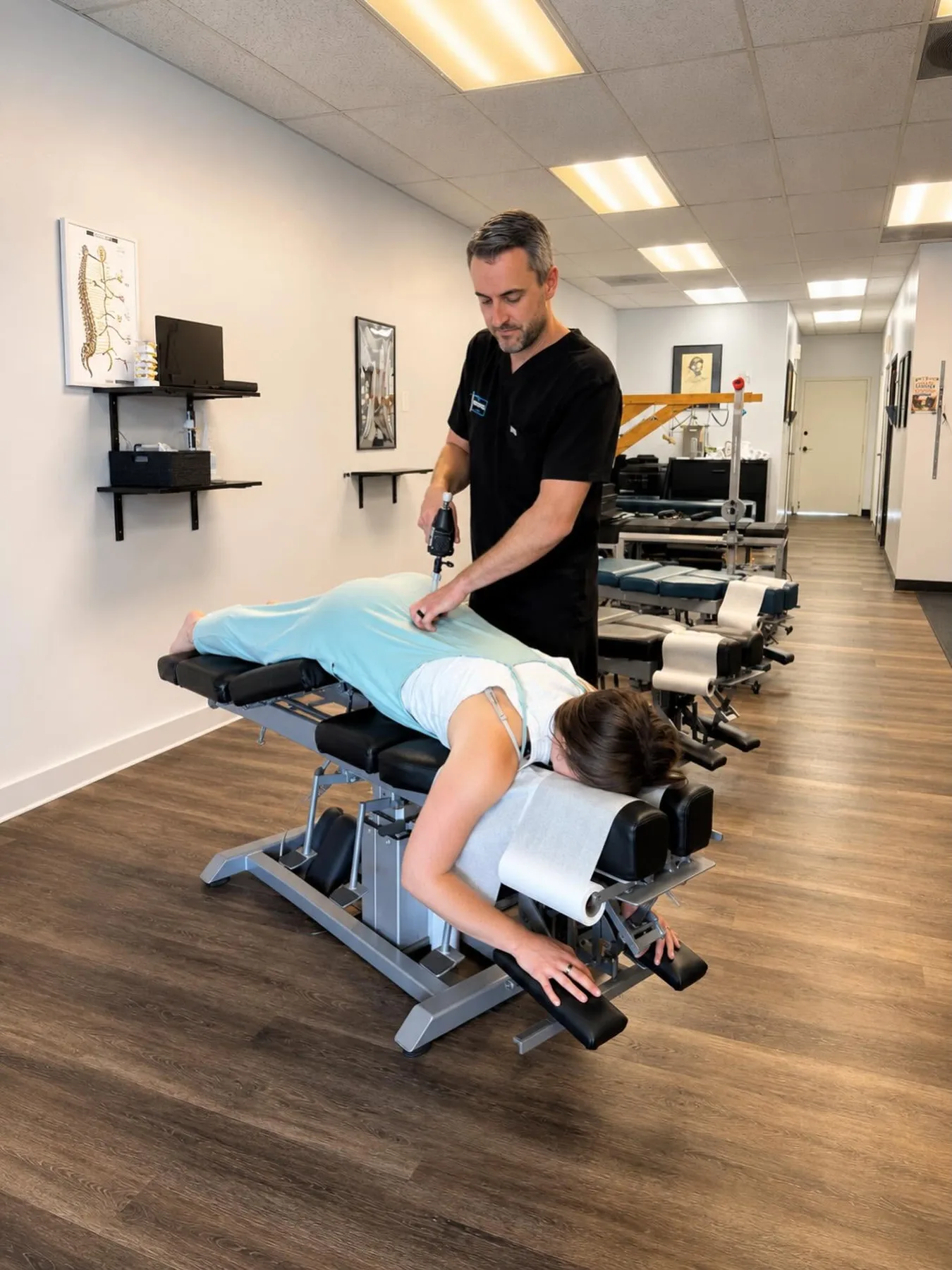
- Denneroll spine-remodeling. A contoured orthotic positions your neck or low back over a precise fulcrum to rebuild the curve that screens and slouching flattened. See Denneroll spine-remodeling for how it works.
- Specific adjustments. Targeted adjustments restore motion to the segments driving the distortion, so traction and exercise hold.
Between visits you’ll have a short set of corrective exercises matched to your distortion — the muscular piece that supports the structural change. We re-measure as we go, so the plan adjusts to your actual progress.
What does posture correction look like before and after?
Picture a side-profile photo at your first visit: the head sitting noticeably forward of the shoulders, the upper back rounding, the chin poking ahead of the chest. Now picture the same photo weeks into care — the head drawn back over the shoulders, the upper back stacked more upright, the neck showing its curve again on X-ray. That’s the change we work toward, and because it’s measured, you see it side by side rather than guessing.
Can chiropractic fix a hunchback?
Honest answer: it depends on what’s causing the rounding. A great deal of “hunchback” in working adults is postural — a flexible, correctable thoracic curve driven by years of sitting and screens — and that responds well to structural correction. But some rounding is from fixed bony changes, advanced arthritis, or conditions like Scheuermann’s that won’t fully reverse. The measurement at your first visit is exactly how we tell the difference. If your case is structural and correctable, we’ll show you the target. If it isn’t, we’ll tell you that plainly and point you toward the right care rather than sell you a plan that can’t deliver.