Condition
Auto Accident & Whiplash
Auto accident and whiplash care in Thousand Oaks — evaluated, documented, and treated from day one
Auto accident and whiplash care in Thousand Oaks — evaluated, documented, and treated from day one
Whiplash is what happens when a sudden force whips your head forward and back faster than your neck can brace for it — most often in a rear-end car accident, even a low-speed one. The muscles, ligaments, discs, and joints of your neck get stretched and torn beyond their normal range in a fraction of a second. The damage is real even when the car barely looks dented.
The part most people don’t expect: you can feel fine the day of the crash. Adrenaline masks injury for hours, sometimes days. It’s common for neck pain, stiffness, headaches, dizziness, and upper-back tightness to surface 24 to 72 hours later — and for some symptoms to keep building for weeks. That delay is exactly why getting evaluated early matters, even when you “feel okay.”
Dr. Nick Brock, DC is a CBP-trained structural chiropractor at 1625 E Thousand Oaks Blvd in Thousand Oaks, serving Westlake Village, Newbury Park, Oak Park, and Agoura Hills. We treat whiplash and auto-accident injuries the way we treat everything else here — measure it first, document what’s actually wrong, then correct it with a written plan you can track. The difference with a crash case is that the documentation does double duty: it guides your recovery and it stands up if your care is billed through insurance or handled by an attorney.
I’ll be straight with you about scope. Chiropractic care is for the neuromusculoskeletal injuries a crash causes — the neck, back, joints, muscles, and nerves. If your exam or imaging shows a fracture, a head injury, or anything that needs an ER or a medical specialist, I will tell you on the spot and get you to the right place. Getting checked early is how we rule those things out, not just how we start treatment.
Get evaluated within 72 hours of the crash — sooner if you can. There are two reasons, and both matter.
First, your recovery. Whiplash tissue heals best when it’s moved and treated correctly early. Left alone, torn soft tissue lays down scar tissue in a disorganized way, and the joints stiffen into protective guarding. That’s how a “minor” crash turns into a stiff neck and headaches you’re still managing a year later. Early care keeps the injury from setting wrong.
Second, the record. If there’s any chance an insurance claim or attorney will be involved, an exam done within days of the crash ties your injuries directly to the accident. A gap of two or three weeks gives an adjuster an easy argument that something else caused your pain. Day-one documentation closes that door.
Go to an emergency room first, not to me, if you have any red-flag signs: loss of consciousness, severe or worsening headache, confusion, slurred speech, weakness on one side, severe neck pain with fever, loss of bladder or bowel control, or numbness that’s spreading. Those need medical imaging and a physician now. Once you’re cleared of anything acute, that’s when structural care starts.
If you’re not sure which category you’re in, call the office at (805) 496-4469 and tell us what happened. We’ll help you figure out the right next step.
It starts with measurement and documentation, not an adjustment. Your first visit after a crash is a full work-up: history of exactly how the accident happened, a chiropractic and orthopedic exam, range-of-motion testing, a neurological screen, and digital posture analysis. X-rays when they’re warranted — and after a crash they often are. Everything is written down in plain language: what’s injured, how severe, and how it connects to the accident.
I’m CBP Trained, which matters more than usual here. Whiplash frequently flattens or reverses the natural curve in your neck — what should be a gentle C-shape gets straightened by the trauma. Chiropractic BioPhysics is built to measure and restore that curve, not just chase the pain. Using specific adjustments, mirror-image traction, and Denneroll spine-remodeling, the goal is to rebuild the structure the crash damaged — so you don’t just feel better this month, you heal correctly.
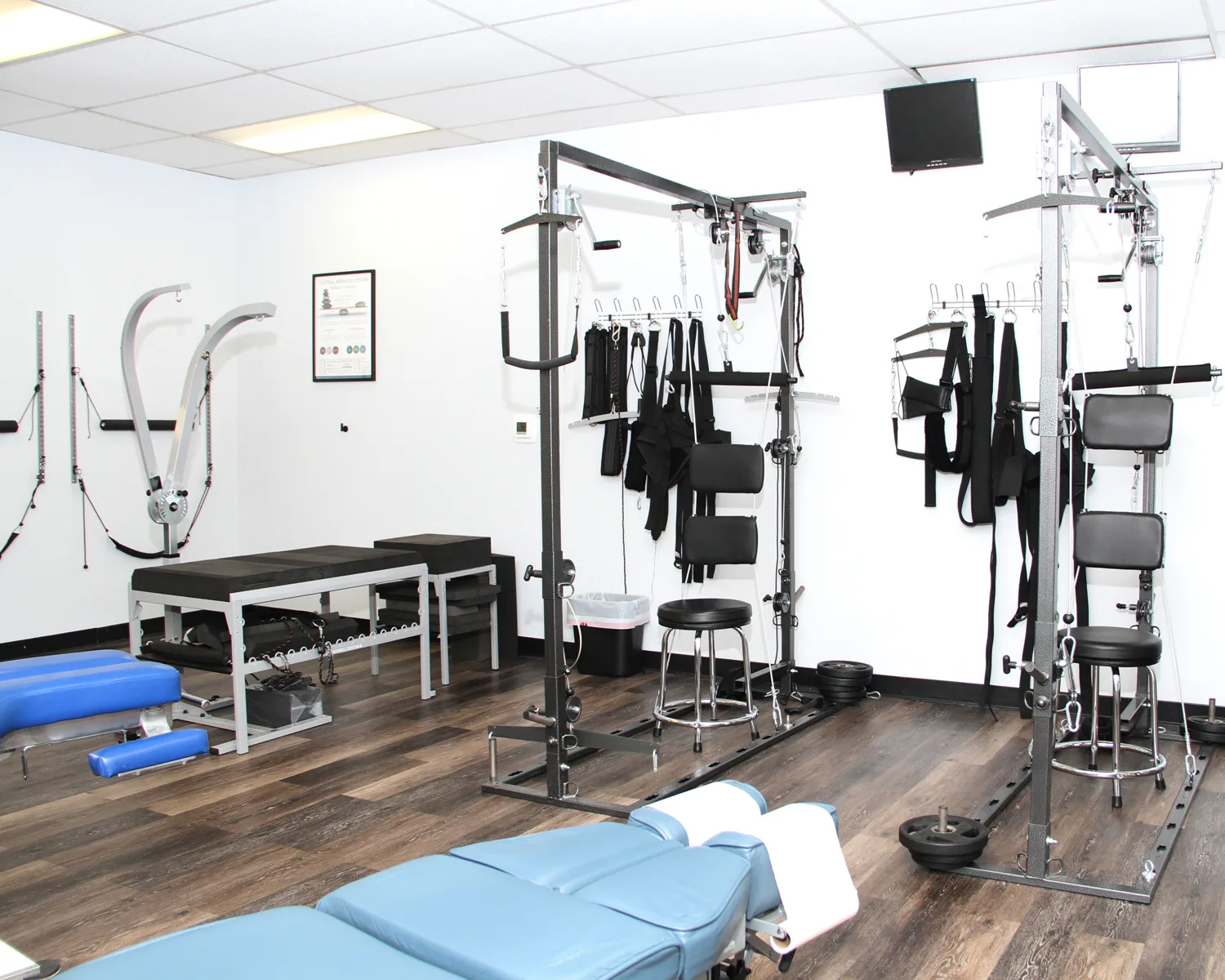
Active recovery is part of the plan. A crash injury isn’t fixed by passive treatment alone. Alongside adjustments and traction, I prescribe targeted rehabilitation — the right movement at the right stage — so the neck and back rebuild strength and stability instead of stiffening up. The same rehab background I lean on for athletes applies directly to getting a crash patient back to normal.
You get re-measured, and so does your file. We re-test range of motion and re-image when appropriate so you can see the progress — and so your record shows objective improvement over time. That progress documentation is what an honest case is built on, whether you’re dealing with your own insurer or an attorney is handling it.
Get examined, rule out anything acute, establish a written baseline tying injuries to the crash, and begin gentle care.
Reduce inflammation, restore safe range of motion, control headaches and guarding, and protect healing tissue.
Restore the neck's natural curve with traction and Denneroll work, layer in strengthening, and recover full function.
Lock in the gains, finish rehab, re-measure against baseline, and discharge with a final documented report.
A chiropractic adjustment is a precise, controlled force applied to a specific spinal joint to restore its motion and ease nerve irritation. We use both hands-on diversified adjusting and CBP mirror-image adjusting built around your actual posture measurements.
Learn more →Sports injury care in Thousand Oaks that treats the biomechanics behind the injury — adjustments, soft-tissue work, and a return-to-play exercise plan — so you get back to golf, tennis, cycling, or running and stay there.
Learn more →Yes — and the sooner the better. Adrenaline masks crash injuries for hours or days, so feeling fine right after isn’t proof you’re uninjured. Whiplash symptoms commonly appear 24 to 72 hours later. Getting evaluated within that window both protects your recovery and creates a record that ties your injuries to the accident. Call (805) 496-4469 and we’ll get you in.
No. Auto-accident and personal-injury visits are billed differently — through your auto insurance, a third party’s insurance, a med-pay claim, or your attorney — so the $39 special doesn’t apply to crash cases. Please don’t book the special for an accident. Instead, call the office at (805) 496-4469 so we can document your case correctly from the first visit and handle the billing the right way.
Yes. We work with patients whose care is being handled through their own insurance, a third party’s insurance, or an attorney, and we provide the detailed exam findings, treatment notes, and progress documentation those cases require. My job is to treat you well and document honestly; the records follow from that. If you already have an attorney, have them contact the office; if you don’t, focus on getting checked first and we’ll point you in the right direction.
It depends on severity, but a typical path runs in phases: a few weeks to calm the acute injury, then roughly one to three months of corrective care to rebuild the neck’s structure and strength, then discharge. Mild cases resolve faster; more severe ones take longer. After your exam we give you a written plan with a measurable end point — not open-ended care. See the recovery timeline above for what each phase looks like.
Two reasons. Medically, whiplash tissue heals best when it’s treated correctly early — waiting lets scar tissue and joint stiffness set in wrong. Legally and financially, an exam done within days of the accident ties your injuries directly to the crash; a multi-week gap gives an insurer room to argue your pain came from something else. Early documentation protects both your recovery and your claim.
Then we’ll tell you and refer you out — that’s part of the evaluation. If your exam or imaging shows a fracture, a head injury, or anything needing an ER or medical specialist, I’ll get you to the right care immediately. Chiropractic handles the neuromusculoskeletal injuries a crash causes; ruling out the rest is exactly why an early evaluation matters. If you have red-flag symptoms right now, go to an emergency room before calling me.
How can we help?
Advanced Chiropractic Rehabilitation · Thousand Oaks
Mon, Wed, Thu 8:00–5:30 · Tue 7:00–11:30 · Closed Fri–Sun