$39 New Patient Special — consultation, exam & X-rays if needed. Call (805) 496-4469
Condition

Neck Pain & Headaches

If your neck aches by mid-afternoon and the headaches follow, the cause is often the same thing: a neck that has lost its natural curve from years of looking down. We measure that curve, show it to you, and work to rebuild it — not just chase the pain. Neck pain chiropractor serving Thousand Oaks and the Conejo Valley.

What is Neck Pain & Headaches?

Most neck pain and a lot of headaches start in the same place — the shape of your neck. Your cervical spine is supposed to hold a gentle backward C-curve. When that curve flattens or reverses, the muscles, joints, and nerves in your neck carry load they were never built to carry. The ache, the stiffness, the headache that creeps up the back of your skull — those are downstream symptoms of an upstream structural problem.

Dr. Nick Brock, DC is a CBP-trained structural chiropractor at 1625 E Thousand Oaks Blvd in Thousand Oaks, serving Westlake Village, Newbury Park, Oak Park, and Agoura Hills. We treat neck pain and headaches by measuring the curve of your neck, correcting what can be corrected, and giving you a written plan with a measurable end — not an open-ended schedule of visits.

Can a chiropractor actually help neck pain and headaches? For most mechanical neck pain, tension headaches, and cervicogenic headaches — the kind that start in the neck — yes, and there’s good research behind it. The honest catch: not every headache comes from the neck. Migraine is its own neurological condition, and some headaches are warning signs of something that needs a medical doctor. My first job is to figure out which kind you have, tell you straight whether we can help, and refer you out if we can’t.

Why does my neck hurt and give me headaches?

It usually comes down to the curve. A healthy neck holds a 40-to-60-degree backward curve that balances the weight of your head — roughly 10 to 12 pounds — directly over your shoulders. When the curve flattens, your head drifts forward, and for every inch it moves forward the effective load on your neck muscles roughly doubles. Hold a bowling ball against your chest and it’s easy; hold it at arm’s length and your arm burns in seconds. Your neck is doing the arm’s-length version all day.

That forward-head load drives three problems at once: the muscles at the base of your skull stay clenched (your tension headache), the small joints in your neck get compressed and irritated (your neck pain and stiffness), and the nerves and vessels through the upper neck get crowded (a cervicogenic headache that wraps around the back of your head and behind your eyes).

What is tech neck — and why is it so common here?

Tech neck is forward-head posture caused by looking down at screens. Tilt your head forward 45 degrees to read a phone and the load on your cervical spine can reach the equivalent of 40 to 50 pounds. Do that for hours a day, for years, and the bent position stops being temporary and becomes your structure. The Conejo Valley runs on desk and tech work — long screen days, long commutes up the 101, the evening scroll — so we see the same pattern constantly in patients from Thousand Oaks, Newbury Park, and Westlake Village. The good news: the same structure that bent under load can be remodeled when you measure it and work it deliberately, the way Chiropractic BioPhysics is built to.
Common symptoms

  • Aching, stiff neck — worse late in the day
  • Tension headaches that band around the head or grip the base of the skull
  • Cervicogenic headaches that start in the neck and travel up
  • Headaches that flare on long screen or commute days
  • Reduced range of motion — trouble checking a blind spot while driving
  • Pain, tingling, or numbness radiating into the shoulder, arm, or hand
  • Forward-head posture you can see in a side photo
  • Dizziness or a 'foggy' feeling tied to neck tension

Common causes

  • Loss or reversal of the cervical curve — Your neck's natural backward curve is its shock absorber. When it flattens or reverses, load stops distributing evenly and specific joints, discs, and muscles take more than their share. This is the structural problem we measure for first.
  • Forward-head posture and 'tech neck' — Years of looking down at screens and phones pull the head forward and flatten the curve. For every inch the head sits forward, neck-muscle load roughly doubles.
  • Prolonged desk work and commuting — Long screen days and the drive up the 101 reinforce the same bent posture thousands of times — the most common driver we see in working adults.
  • Clenched suboccipital muscles — The small muscles at the base of the skull stay guarded under forward-head load, producing the classic band-like tension headache.
  • Irritated upper cervical joints — Compressed, restricted joints in the upper neck can refer pain up into the head — the mechanism behind a cervicogenic headache.

When to seek chiropractic care

We want to be clear about scope. True migraine is a neurological condition — while reducing neck-driven triggers genuinely helps many migraine patients, I’m not claiming to cure migraine.

Treat these as medical emergencies — go to urgent care or the ER, not a chiropractor:

  • A sudden “worst headache of your life”
  • A headache with vision loss, slurred speech, or weakness on one side
  • Fever with a stiff neck
  • A headache after a hard blow to the head

If your headaches don’t fit a mechanical pattern, we’ll refer you to a physician rather than treat something that isn’t mine to treat. For the common case — neck-driven pain and headaches — the honest first step is to measure it. The $39 New Patient Special exists for exactly that.

Our approach

It starts with measurement, not adjustment. At your first visit we take a digital posture analysis and, when warranted, a cervical X-ray read with PostureRay — software built to measure the exact angle of your neck curve. That tells us whether the curve is healthy, flattened, or reversed, and by how much. We’re not guessing; we have a number, and we can re-measure it later to see if the plan is working.

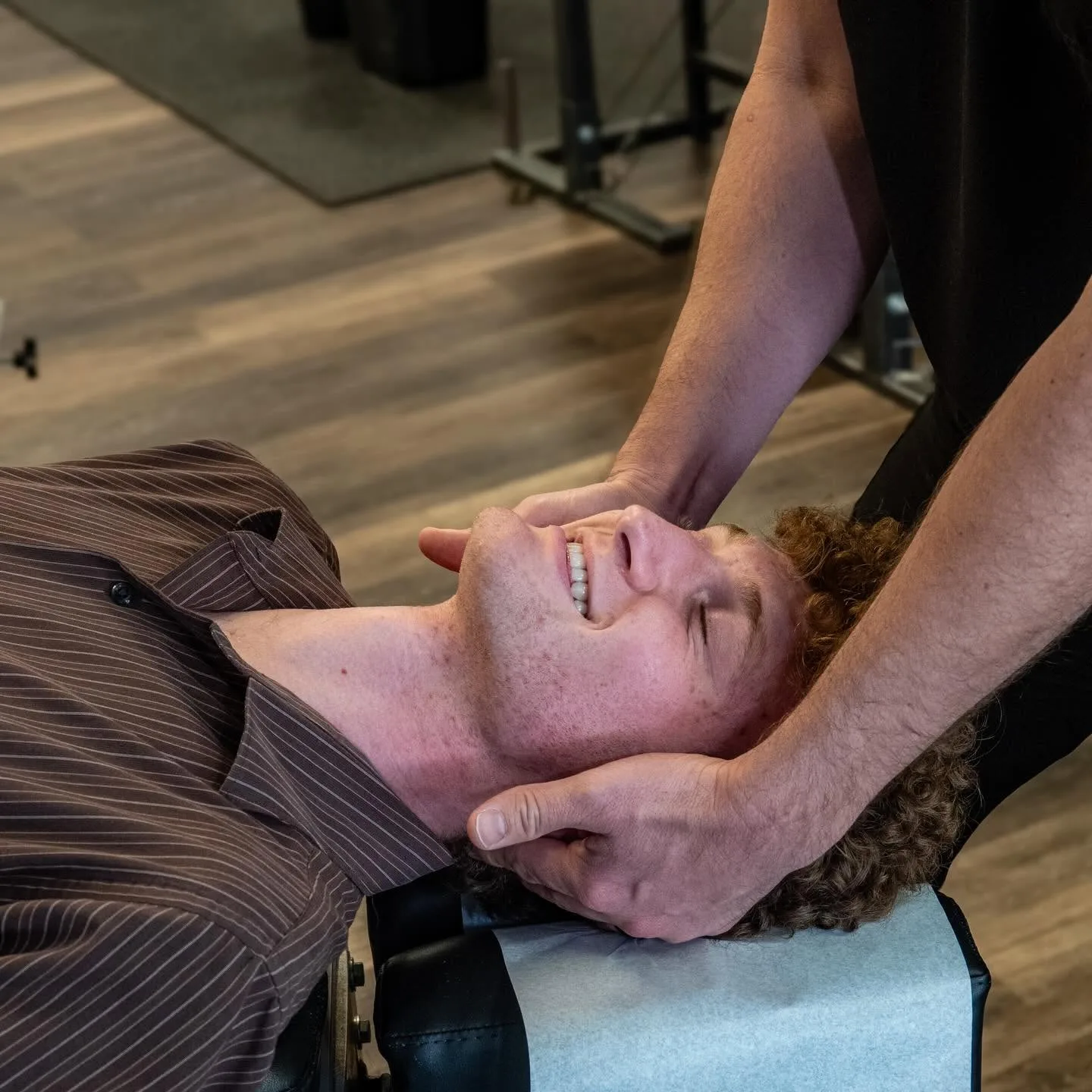
Then we correct the structure. My core tools are specific spinal adjustments to restore motion to stuck joints, mirror-image cervical traction to load the neck opposite its damaged direction, and Denneroll spine-remodeling — a contoured fulcrum you lie back over that gently coaxes the backward curve to return over weeks. Add soft-tissue work for the clenched muscles at the base of the skull and home exercises that retrain your posture, and you’re not just relieving today’s headache — you’re changing the structure that keeps producing it. That’s the point of posture correction.

How CBP restores the curve in your neck

Chiropractic BioPhysics is the most peer-reviewed technique in chiropractic, and it treats your spine as a structural unit you can measure and remodel. Most chiropractic eases neck pain by mobilizing stiff joints — useful, but it doesn’t change the shape of the neck driving the headaches. CBP adds the missing piece: we measure exactly how your curve has deformed, then load your neck in the precise opposite direction through adjustments, traction, and Denneroll remodeling, so tissue and bone slowly remodel back toward a normal curve. Read the full method on the Chiropractic BioPhysics page.

And you get a finish line. Every plan I write has a measurable end point and a re-exam to prove it worked. I’d rather you graduate with a restored curve than keep coming back forever. If we re-measure and the curve isn’t moving, we change course.

Typical care timeline

Relief phase

Duration: First few weeks
Frequency: More frequent up front — typically 2–3 per week — because acute tissue responds to consistency.

Calm the headache pattern and the clenched suboccipital muscles, restore joint motion, and break the daily flare cycle.

Corrective phase

Duration: Several weeks to a few months, depending on your measured curve
Frequency: Tapering as the curve holds — often 1–2 per week, with re-measurement so you can see the change.

Rebuild the cervical curve and correct forward-head posture using adjustments, mirror-image traction, and Denneroll remodeling.

Stabilization / graduation

Duration: Final stretch of the plan
Frequency: Spaced-out visits, then a planned end point. Optional periodic check-ins only if you want them.

Lock in the corrected curve with rehab and home exercise, confirm it holds on its own, and get you out of regular care.

Frequently asked questions

Can a chiropractor help my tension headaches?

Often, yes. Tension headaches usually come from clenched muscles at the base of the skull and a neck that’s lost its curve — both things we can measure and treat. I combine specific adjustments, cervical traction, soft-tissue work, and posture retraining to take load off those muscles. Many patients notice fewer and milder headaches within the first few weeks, though a full structural correction takes longer.

Are you a migraine chiropractor — can you cure my migraines?

We won’t promise to cure migraine; it’s a neurological condition, not a structural one. What we can do is reduce the neck-based triggers that set many migraines off — forward-head posture, tight upper-neck muscles, irritated cervical joints. Plenty of migraine patients get meaningful relief when we calm the neck down, but I’ll be honest at your exam about whether your headaches look migraine-driven, neck-driven, or both, and coordinate with your physician where it makes sense.

What is tech neck and can it be reversed?

Tech neck is forward-head posture from years of looking down at screens — it flattens or reverses the natural curve of your neck and overloads the muscles and joints. It can often be improved and sometimes substantially reversed, but not by stretching alone. It takes measured structural correction — adjustments, mirror-image traction, and Denneroll spine-remodeling — to remodel the curve over weeks. We measure where you start and re-measure to prove it’s changing.

How long until my neck pain and headaches improve?

It depends on how long the problem’s been building and how far the curve has shifted. Many patients feel less pain and fewer headaches in the first few weeks. Restoring the actual curve — the change that keeps the relief lasting — usually takes a course of care measured in weeks to a few months. You’ll get a specific timeline in writing at your report of findings, plus a re-exam to confirm we’re on track.

Do you see patients from Newbury Park and Westlake Village?

Yes. The office is at 1625 E Thousand Oaks Blvd, Suite E, an easy drive from Newbury Park, Westlake Village, Oak Park, and Agoura Hills. We’re open Monday, Wednesday and Thursday 8:00–5:30 and Tuesday afternoons. Because we keep the schedule deliberately light, the fastest way to get in is to call (805) 496-4469 or book online.

Your solution to pain.

CBP-trained structural chiropractic care in Thousand Oaks. Book your first visit today — new patient special $39.

Call Book Directions