Condition
Sciatica Relief
Non-surgical care for sciatica, pinched nerves, and disc-related leg pain
Non-surgical care for sciatica, pinched nerves, and disc-related leg pain
Sciatica is a symptom, not a diagnosis. The word describes pain that travels along the path of the sciatic nerve — the largest nerve in your body, about as thick as your thumb where it leaves the spine. It forms from nerve roots in your lower back (L4 through S3), runs deep through the buttock, and travels down the back of the thigh and calf into the foot. When something irritates or compresses one of those roots, the pain doesn’t stay local. It shoots, burns, or zings down the leg, often well past the original problem.
So when someone tells me “I have sciatica,” my first job isn’t to treat the leg. It’s to find out why the nerve is angry in the first place. In most cases we see in Thousand Oaks, the culprit is one of a handful of things: a bulging or herniated disc pressing on the nerve root, narrowing of the bony channels the nerve passes through (stenosis), arthritic changes, or — and this is the one most people miss — a spine that has lost its normal structure and is loading those nerve roots unevenly with every step and every hour at a desk.
That last point is where our approach differs from a clinic that only does spinal decompression or only does massage. Dr. Nick Brock, DC is a CBP-trained structural chiropractor at 1625 E Thousand Oaks Blvd in Thousand Oaks, serving Westlake Village, Newbury Park, Oak Park, and Agoura Hills. We treat the sciatic nerve’s environment — the curves and alignment of the spine that decide how much room that nerve has — not just the spot where it hurts. If we only chase the leg pain, it tends to come back. If we change the structure driving it, we have a real shot at lasting non-surgical relief.
One honest note up front: true sciatica and surgery are not the same conversation. The large majority of sciatica improves with conservative care and never needs an operation. But a small number of cases do — and we’ll tell you plainly if yours is one of them. (See “when to seek care” below for the warning signs that mean skip the chiropractor and go straight to a hospital.)
Most sciatica is not an emergency, and most of it gets better. But a few signs mean you should bypass conservative care and get medical attention immediately — same-day, ER if needed:
None of those describe you? Then you’re in the large group of people whose sciatica responds well to careful, conservative, non-surgical care. The smartest first step is to get an accurate picture of what’s actually compressing the nerve — which is exactly what your first visit is for. The longer a nerve stays irritated, the more stubborn it gets, so earlier is genuinely easier than later.
First, we find out whether it’s really coming from your spine. Your first visit is a full work-up, not a quick crack: history, orthopedic and neurological testing (reflexes, strength, sensation, nerve-tension tests), and a digital posture analysis. If the picture points to a disc or a nerve root, we’ll take X-rays when they’re warranted so we can measure your actual spinal structure with PostureRay — the angle of your lumbar curve, how your vertebrae sit, where load is concentrating. You can’t correct what you haven’t measured.
Sciatica vs. piriformis syndrome — how we tell them apart. This matters because the treatments diverge. True sciatica from a disc or nerve root usually sends pain below the knee, often with numbness or tingling in a specific band of the leg or foot, and it’s frequently provoked by a straight-leg-raise test or by bending forward, coughing, or sneezing. Piriformis syndrome tends to stay in the buttock and upper thigh, is reproduced by pressing on or stretching that deep hip muscle, and rarely causes the same below-the-knee neurological signs. Same burning leg pain, two different sources. Get this wrong and you can spend months treating a muscle when the problem is a disc, or vice versa. Sorting it out is part of what your exam is for.
Then we treat the structure, not just the symptom. I’m CBP Trained. Chiropractic BioPhysics is the most peer-reviewed technique in chiropractic, and it treats your spine as a structural unit. For sciatica that means three coordinated tools:
How that compares to spinal decompression and surgery. Standalone spinal decompression (motorized traction) can ease disc pressure and offer real short-term relief — but on its own it doesn’t address why the disc was overloaded, so the pain often returns. CBP uses traction too, but as part of correcting the spine’s structure, not as the whole plan. Surgery (microdiscectomy, laminectomy) is a legitimate and sometimes necessary option — but it’s appropriate for a minority of cases, usually after conservative care has had a fair trial or when there are progressive neurological signs. My role is to give your nerve every reasonable chance to recover without an operation, and to be honest when it’s time to involve a surgeon.
And we measure whether it’s working. We re-test and re-measure as your care progresses, so you can see the change rather than take our word for it. If you’re not improving the way the plan predicts, we change the plan — or we refer you on. Sciatica and ordinary low back pain often travel together, so addressing the structure usually helps both.
Calm the irritated nerve, reduce the burning leg pain, and restore movement to the involved segments.
Rebuild the lumbar curve and alignment with Denneroll and traction so the nerve root keeps its room and the disc stops being overloaded.
Lock in the correction with rehab and periodic checks; graduate you from active care.
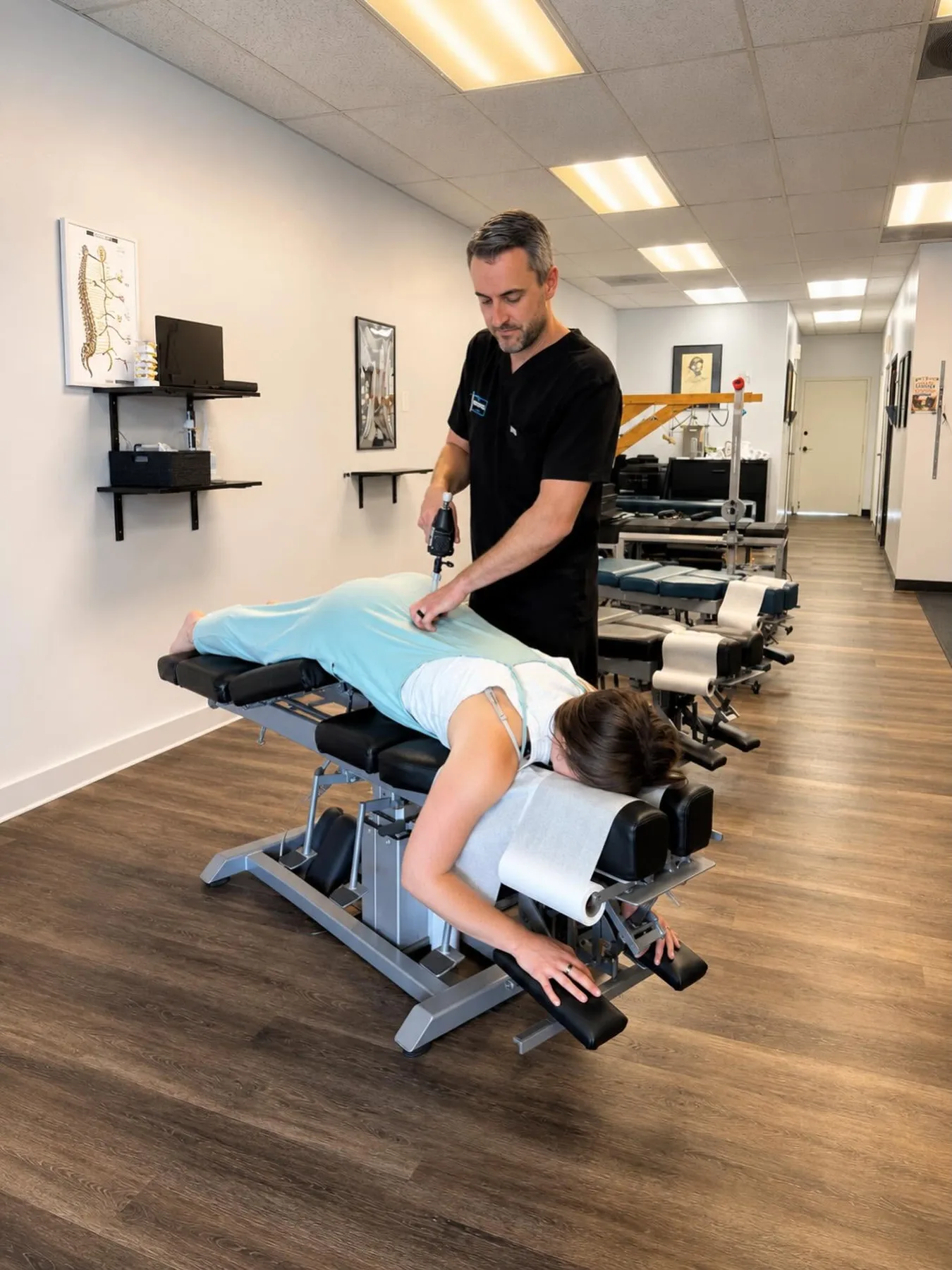
A chiropractic adjustment is a precise, controlled force applied to a specific spinal joint to restore its motion and ease nerve irritation. We use both hands-on diversified adjusting and CBP mirror-image adjusting built around your actual posture measurements.
Learn more →A Denneroll is a contoured spinal orthotic that applies gentle, sustained traction to remodel the natural curve of your neck or lower back over time — the home-and-office tool behind structural correction at Advanced Chiropractic Rehabilitation.
Learn more →For the common causes — a disc pressing on a nerve root, lost lumbar curve, joint restriction — yes, conservative chiropractic care helps a large share of sciatica without surgery. But we don’t mask it. We measure what’s compressing the nerve and treat that structure with specific adjustments, Denneroll spine-remodeling, and rehab. If your case has warning signs that need a medical specialist, we’ll tell you on day one and refer you out rather than string you along.
Rough rule of thumb: true sciatica from the spine usually sends pain below the knee, often with numbness or tingling, and gets worse when you bend forward, cough, or sneeze. Piriformis syndrome tends to stay in the buttock and upper thigh and flares when that deep hip muscle is pressed or stretched. They feel similar, but the source — and the right treatment — is different, which is exactly why your first visit includes the orthopedic and nerve-tension testing to tell them apart.
Decompression (motorized traction) can give real short-term relief by easing pressure on the disc — but used alone it doesn’t fix why the disc was overloaded, so the pain often comes back. My approach uses traction as one piece of correcting your spine’s actual structure with Chiropractic BioPhysics, so the disc stops getting crowded in the first place. For a true bulging disc, that structural correction is usually the more durable answer.
Most likely not. The large majority of sciatica improves with conservative care and never needs an operation. Surgery is appropriate for a minority of cases — usually after a fair trial of non-surgical care, or when there are progressive neurological signs like worsening weakness. My job is to give your nerve every reasonable chance to recover without surgery, and to be straight with you about when it’s time to involve a surgeon.
Many patients feel the burning leg pain ease within the first few weeks of the relief phase, though that’s not a promise — it depends on what’s compressing the nerve and how long it’s been there. Rebuilding the lumbar structure that’s driving it takes longer, often several weeks to a few months. We’ll give you a realistic, written timeline at your report of findings, and we re-measure along the way so you can see whether it’s working.
Your first comprehensive visit is $39 with our New Patient Special — a $140 value — which covers the consultation, full exam, digital posture analysis, X-rays if they’re indicated, and a written care plan that lays out whether we can help, how long it should take, and what it costs. (Note: if your sciatica is from an auto accident, that’s billed through insurance or your attorney, so the $39 special doesn’t apply.)
How can we help?
Advanced Chiropractic Rehabilitation · Thousand Oaks
Mon, Wed, Thu 8:00–5:30 · Tue 7:00–11:30 · Closed Fri–Sun