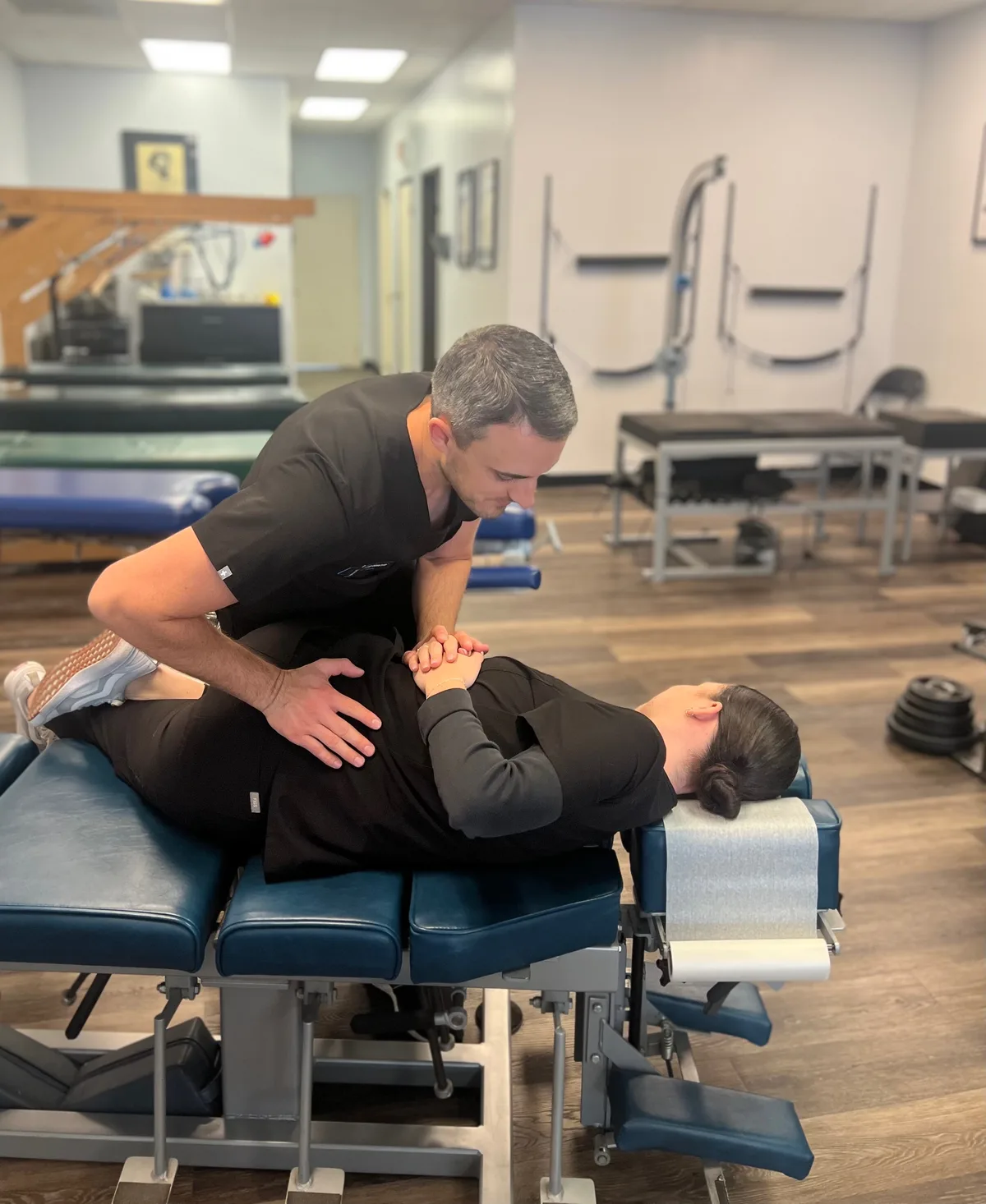
How it works
There are two kinds of adjustment we use here, and it helps to understand both.
Diversified manual adjusting is the chiropractic technique most people already picture. I position the joint, then deliver a quick, controlled, low-amplitude thrust by hand. It’s specific — one segment at a time — and it’s fast, which is exactly why it’s comfortable. That noise you hear isn’t bone on bone. It’s a gas bubble releasing inside the fluid of the joint, the same harmless pop you get from your knuckles. It’s called cavitation, and it is not a measure of whether the adjustment “worked.” A good adjustment can be completely silent.
CBP mirror-image adjusting is where my training goes a step further. After your digital posture analysis and X-rays, I know which direction your spine has drifted — forward head, a lost neck curve, a shoulder or pelvis that sits high. Mirror-image adjusting applies the correction in the opposite direction of the distortion, so we’re not just freeing up a stuck joint, we’re nudging the whole structure back toward its normal alignment. This is part of Chiropractic BioPhysics, the most peer-reviewed technique in the field, and it’s what separates structural correction from a quick crack-and-go.
Which one we use, where, and how often is decided by your measurements — not by routine. Some visits are purely manual. Many pair the adjustment with mirror-image traction or Denneroll spine-remodeling so the correction actually holds between appointments.